



Fine pitch gears rethought: instead of lowering safety factors, recent research now allows size factors > 1.0 – for a more reliable and robust design.
For decades, the calculation standards DIN 3990 and ISO 6336 have provided the foundation for load capacity verification of metallic gears. However, both standards were originally established for cylindrical gears with a normal module mn ≥ 2 mm. They include a size factor < 1.0 to account for the decreasing material strength with increasing dimensions.
In practice, this led to a common engineering approach over the past 30 years:
When designing small module spur gears (mn = 1.0 mm down to 0.5 mm), engineers often worked with very low minimum required safety factors, often even below 1.0, to avoid overdimensioning.
That approach worked. But it was never fully satisfying from a methodological perspective.
What Has Changed?
Recent research has now systematically investigated the size effect in the direction of smaller dimensions, particularly for case-hardened carburizing steels. The result:
Size factors > 1.0 are now proposed for mn ≤ 1.0 mm for case hardened steel.
Key publications include:
https://lnkd.in/dC6sDHVV
https://lnkd.in/dbVQzQRW
These findings provide a scientifically grounded alternative to the previous workaround of simply lowering safety factors.
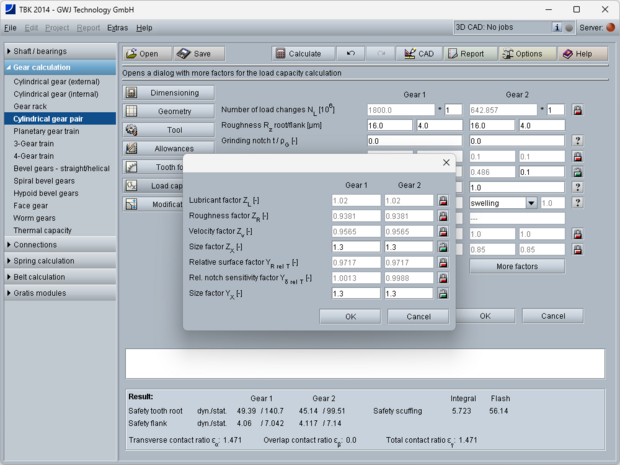
The TBK software now enables this approach directly. In the modules for:
- Cylindrical gear pairs
- Planetary gear trains
- 3- and 4-gear train systems
- Rack and pinions
the size factors in load capacity calculations according to:
- DIN 3990 Method B and
- ISO 6336 Method B
can now be individually specified with values > 1.0.
Especially in new developments, where empirical values or established experience for reduced safety margins are lacking, this approach brings clarity and confidence.